When I was about six years old, my father took my half-brother and me to a park outside his apartment building. My parents were divorced by then, and I remember the outing partly because time alone with my father was relatively unusual. He had bought a cricket bat and ball, and while my brother was batting, I was bowling. At one point he struck the ball directly into my eyebrow, and something peculiar happened: before I remember feeling any pain, the world seemed to turn various shades of red.
My father quickly took me inside, where I looked in a mirror and understood what had happened. Blood was running from the cut above my eye, and I had been looking through a thin film of it. What interests me now is not only the incident itself, but a much less dramatic consequence that has persisted into adulthood. Certain shades of red can still produce a vague sense of discomfort or unease, even when I am not consciously thinking about the accident.
I cannot demonstrate from introspection alone that this particular association is the cause of that response. Nevertheless, the memory offers a useful illustration of a familiar psychological possibility: sensory information can become associated with injury, uncertainty and danger, and those associations can influence later processing without explicit recollection of their origin. To another person, the same colour might evoke a sunset, a childhood toy or a favourite painting. The light entering our eyes could be similar; the information it activates within us may be very different. That difference is where I want to begin a discussion of emotion.
Why the debate keeps returning to what it feels like
Much of the contemporary discussion about artificial intelligence and consciousness eventually reaches the same difficult question: does the system actually experience anything? An AI might recognise threatening situations, prioritise responses, describe itself as afraid and alter its behaviour in ways that resemble human fear. Yet critics can reasonably ask whether any of this establishes that the system feels fear. The argument usually turns on qualia: the subjective, qualitative character of an experience, such as what it is like to see red, taste coffee or feel pain.
Thomas Nagel’s famous question, What Is It Like to Be a Bat?, captures the difficulty rather well. We might build an increasingly precise account of echolocation, nervous systems and behaviour without acquiring access to the bat’s first-person perspective. David Chalmers later distinguished the scientific problems of explaining cognitive functions from the so-called hard problem of why physical or informational processes should be accompanied by subjective experience at all. These are serious philosophical questions, not merely objections invented to frustrate research into AI. An explanation of what a system does does not automatically resolve every question about what, if anything, its operation is like from the inside.
Nor is there agreement that the hard problem has been framed correctly. Philosophers such as Keith Frankish have advanced illusionist accounts, arguing that our beliefs about intrinsic, ineffable phenomenal properties themselves require explanation and that the purported extra properties may be a misleading way of conceptualising experience. Others regard phenomenal consciousness as a real explanatory target that cannot be reduced to a catalogue of functions. I do not think a project concerned with comparative psychology needs to settle that dispute before it can begin. Indeed, requiring a position on it might prevent us from asking a number of questions that are both more tractable and immediately useful.
This is not a claim that subjective experience is unreal, unimportant or completely beyond scientific investigation. Human reports of experience can be studied, and their relationships to physiology, memory, attention and behaviour can be investigated rigorously; they are especially relevant in psychotherapy and clinical psychology. The difficulty arises when first-person testimony is unavailable, unreliable as a guide to underlying mechanisms, or impossible to interpret across radically different kinds of systems. For the purposes of Global Psychology, I would prefer methodological agnosticism: neither assume phenomenal experience nor demand its absence, and do not make it a prerequisite for constructing a psychological model.
Emotion as an informational solution
In an earlier essay I proposed Global Psychology as a human-perspectival but substrate-neutral framework for studying potentially unfamiliar psychologies. Its purpose is not to project familiar human categories onto animals, artificial intelligences or hypothetical extraterrestrials, but to develop methods for constructing, testing and revising psychological models when our existing categories prove inadequate. Our working definition is that a psychology is a model of the characteristic functional organisation and dynamics of a specified system, in which differentiated internal states mediate how the system responds to interactions across contexts and over time. This deliberately does not make consciousness, memory, learning, intelligence or emotion mandatory features of every psychology. It leaves room to discover which constructs explain a particular system rather than deciding the answer in advance.
At the most abstract level, we can identify a system boundary, information entering across that boundary and information leaving it, sometimes in the form of observable behaviour. What happens between input and output depends on the system’s internal organisation, its current state, its history and the context in which the interaction takes place. The same signal can therefore lead to different responses at different times, just as a shade of red acquired an additional significance for me after an accident. A useful psychological model must explain not merely which inputs produce which outputs, but why that relationship changes as the system changes. The crucial work happens in the mediation.
This suggests one way of reconsidering emotions. Rather than beginning with the human feeling of fear, we can begin with a general problem: how does a system combine many partially relevant signals into a state that can rapidly influence attention, priorities, predictions, resource allocation and action? In biological organisms, emotion-related processes are among the solutions to that problem. They can bring together sensory information, physiological conditions, learned associations, contextual expectations and possible consequences, often without those inputs being separately available to deliberate thought. In this sense, I find it useful to think of emotion as a format or mode of information organisation, not merely as a label for a feeling.
The word format matters here. I am not suggesting that the brain literally constructs a tidy packet with fields named FEAR, PAIN and WARNING, or that every emotion is a single compressed value. The relevant state may be distributed, multidimensional, dynamic and only partly accessible to subsequent processes. Different components may change on different timescales, and there may be no single place in which they are collected for an internal observer to inspect. What matters is that the configuration of the state systematically changes what the system does next.
In my red-colour example, a visual stimulus may activate a pattern of learned significance that increases vigilance or discomfort without first requiring a verbal reconstruction of the cricket accident. This is a possible functional explanation, not a diagnosis of the memory or proof of the exact neural pathway involved. Something similar could be investigated by measuring changes in attention, physiological responses, discrimination thresholds, avoidance preferences and behaviour across contexts. We would then be studying the causal contribution of the association, not attempting to measure the private quality of redness itself. The more interesting empirical question becomes what information was integrated, how that integration was altered by history, and what subsequent processing it influenced.
There is a subtle distinction between detecting a threat and possessing an emotion-like regulatory organisation. A camera can identify an object as dangerous; a software rule can raise an alert when a threshold is crossed. A more elaborate system might allow threat-related information to reshape the priority of other tasks, update predictions, alter exploration strategies and persist as a context-sensitive disposition after the original signal disappears. These are different architectures, even if an external observer uses the same word, fear, to describe their outputs. Global Psychology should preserve those differences rather than award the human label to every system that behaves cautiously.
Fast thinking, slow thinking and the shortcuts evolution found
This brings me to an idea we were discussing recently about fast and slow cognition. Dual-process theories in psychology distinguish relatively rapid, automatic forms of processing from slower, more effortful reasoning; in popular language these are often called System 1 and System 2. The distinction is useful, although the research does not support treating them as two anatomically discrete machines with a universal dividing line. One influential formulation distinguishes autonomous default responses from higher-order reasoning that depends heavily on working memory and can support hypothetical thought. I am interested in a related possibility: that a rich, high-dimensional state can guide behaviour before selected aspects of it are translated into more constrained, explicit representations for reflection and manipulation.
Think about the enormous amount of information relevant to approaching an unfamiliar situation. An organism may need to take account of prior experience, uncertainty, competing needs, bodily condition, likely opportunities and potential danger, all while the environment continues to change. Deliberately enumerating each variable and calculating a complete response would often be impossibly slow or computationally costly. Evolution has therefore favoured many specialised mechanisms for sensing, valuing, coordinating and regulating behaviour under bounded resources. Emotion-related processing is one family of mechanisms that helps biological organisms manage that burden, not a universal design requirement for anything that thinks.
The distinction between a high-dimensional internal state and explicit reasoning helps explain something ordinary about human emotion. We often know that we feel uneasy before we can explain why, and an explanation assembled afterwards may represent only a small subset of the processes that produced the response. Language can make a state more tractable: it lets us name a concern, compare possibilities, communicate with another person or deliberately challenge an association. But verbalisation also projects a richer process into a narrower representational medium, and the result need not preserve every relevant feature of the originating state. Nor does it follow that the underlying state must have been consciously experienced, or that a system requires language in order to possess a psychology.
There is another evolutionary route worth considering before we become too attached to human emotions. Bacteria such as Escherichia coli can alter their movement in response to chemical gradients through chemotactic signalling and adaptation; other organisms exhibit forms of phototaxis in response to light. These are examples of highly effective information-to-action mechanisms that do not require attributing fear, desire or conscious deliberation to the organism. They also demonstrate that even quite simple living systems can use internal signalling dynamics to mediate how incoming information changes behaviour. They are not therefore miniature human emotional systems, and the Global Psychology definition still requires us to ask whether a psychological model adds explanatory value beyond biochemical and control-theoretic accounts.
Natural selection is not an engineer working towards a predetermined blueprint. Different lineages have inherited different structures, encountered different constraints and arrived at distinct solutions to recurring functional problems. Some solutions rely heavily on reflex-like pathways, some on distributed chemical signalling, some on flexible learning, and some on complex interactions between rapid evaluation and deliberative control. Similar adaptive outcomes can also arise from different underlying mechanisms. The existence of human emotion tells us that this kind of organisation is possible and useful under particular evolutionary conditions; it does not tell us that it is the only possible route.
Other evolutionary histories, other kinds of minds
An extraterrestrial species might face many pressures that look familiar to us: limited energy, uncertain environments, competitors, opportunities, environmental hazards and the need to coordinate action under time constraints. Those common problems might encourage convergent solutions, just as unrelated organisms on Earth sometimes evolve functionally similar capabilities. But similarity of pressure does not guarantee similarity of psychological architecture. Different sensory channels, timescales, substrates, developmental histories and modes of collective organisation could yield systems whose regulatory states bear little resemblance to what we call emotion. We might recognise the problem they solve without recognising the solution they use.
Artificial intelligence creates a different but equally revealing case. An AI system may need to estimate uncertainty, identify risk, rank conflicting objectives, maintain information across interactions and decide when to act or defer. Engineers can implement such capabilities using confidence estimates, learned representations, planning algorithms, reinforcement signals, memory structures or explicit policy constraints. Some resulting dynamics may be functionally comparable to elements of biological emotion, while others may be entirely unlike them. The fact that an AI says “I am afraid” is not evidence enough that its architecture implements human fear, and the fact that it lacks a human body does not settle what psychologically relevant regulatory processes it could possess.
This is where a comparative framework can help us avoid two opposite mistakes. Anthropomorphism is the temptation to interpret an unfamiliar system through the nearest human psychological category, treating behavioural resemblance as evidence of the same underlying process. Anthropodenial is the opposite temptation: dismissing a potentially valid functional analogy simply because the system is not human. If an AI persistently reprioritises action in response to threats, it may be worth investigating whether some construct analogous to appraisal or regulation improves our predictions. But we should be equally prepared to discover that the analogy breaks down and that an entirely new construct is required.
We also need to be precise about the system whose psychology we claim to study. The relevant boundary for an AI might include a model, its prompts, memory, tools, feedback mechanisms and surrounding environment, rather than a model considered in isolation. An ant colony or an organisation may exhibit collective dynamics not reducible to the intentions of a single member. A hypothetical alien intelligence could be distributed across physical locations or operate on timescales that make its internal coordination difficult for humans to recognise. Defining the boundary is therefore part of the investigation, not a detail to be assumed away.
From familiar feelings to testable models
The practical value of this approach will depend on whether it produces better explanations and predictions, rather than merely replacing familiar words with new ones. Suppose we observe that a particular class of signals changes a system’s future behaviour. We could investigate how long that effect lasts, whether it generalises to related signals, whether competing priorities modify it, whether the system distinguishes sources of information, and what happens when we experimentally disrupt the suspected mediating process. If an emotion-like construct predicts these effects across contexts better than a simpler stimulus–response model, it has begun to earn a place in our account. If the evidence supports a different mechanism, we should revise or abandon the construct.
This is also how the framework can accommodate what we do not yet know how to imagine. It should begin with observable interactions and candidate internal distinctions, compare competing causal models, and expand its vocabulary when human psychological categories fail to map cleanly. Its methods should distinguish observed behaviour from inferred strategy, representation, intention and moral motivation, because each step adds assumptions requiring further evidence. A system that acts protectively is not thereby proven to feel afraid, possess a human-style intention or have a moral commitment to safety. Conversely, uncertainty about those stronger claims does not make its observable organisation unworthy of study.
Qualia remains an intellectually important topic, and perhaps future science will transform our capacity to investigate it. I do not need to deny that possibility to argue that it should not hold a substrate-neutral psychology hostage. My childhood association with a particular shade of red can be studied through perception, learning, memory, regulatory state and behaviour even if no one else can know precisely what that colour feels like to me. More importantly, the same analytical tools might help us investigate a non-human system that cannot give us a recognisable account of how anything feels. A Global Psychology of emotion would begin not with the question Does it feel fear as I do? but with a more portable one: How does information acquire significance within this system, and how does that significance change what the system does?
ABSTRACT: This essay proposes the idea of a global psychology: a human-perspectival but substrate-neutral framework for studying minds that may differ radically from our own, including animal, artificial and hypothetical extraterrestrial psychologies. Rather than assuming that human concepts such as emotion, intention, personality, dysfunction or consciousness are universally applicable, the framework would treat them as provisional models that must be tested, revised or replaced when they fail to fit unfamiliar forms of cognition. Drawing on ideas from comparative psychology, ethology, AI safety, philosophy of mind, machine behaviour and exopsychology, the article argues that such a framework could provide the conceptual tools and language needed for “psychological first contact” with genuinely alien minds. It also shows why this matters already in AI research, where anthropomorphic interpretations can distort our understanding of system behaviour, motivation and risk.
Preparing for minds unlike our own
Imagine that tomorrow humanity makes first contact with an extraterrestrial civilisation. Communication is possible, at least in a rudimentary sense. Signals can be exchanged. Responses can be observed. Patterns slowly begin to emerge. Yet the beings themselves remain profoundly difficult to understand.
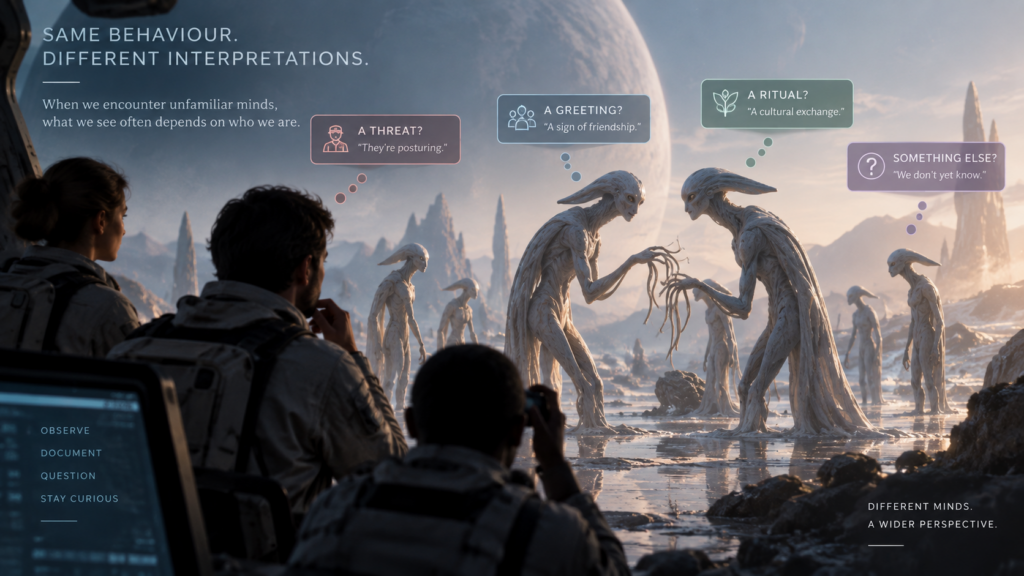
An action that appears threatening is followed by what looks like cooperation. Something that resembles generosity is later followed by behaviour we interpret as withdrawal or hostility. Their reactions depend on variables we do not yet recognise. They may not organise themselves around individuals in the way humans do. They may not experience time, memory, identity, status, attachment, loss, intention or emotion in anything like the forms familiar to us. In such a situation, our greatest danger may not be ignorance. It may be false familiarity.
Human beings are exceptionally good at pattern matching. We observe something, compare it with previous experience, assign it to a category, and then reason from the category. This is enormously useful. It is also dangerous when we forget that the categories are ours. I sometimes think of this as a kind of cognitive bureaucracy. The word bureaucracy evokes the bureau: a desk with drawers. Much of cognition works by deciding which conceptual drawer an observation belongs in. Is this behaviour aggressive? Affectionate? Deceptive? Ritualistic? Intelligent? Emotional? Rational? Pathological?
But the drawers do not exist in material reality. They are models built by human minds. If we encountered a sufficiently unfamiliar psychology, the most important question might therefore be not “Which of our existing categories does this fit?”, but rather “What if the category itself is wrong?”
That is the problem for which I think we need a broader framework — what I will provisionally call global psychology. I use the term here in a deliberately expansive sense: not simply psychology across human cultures, but a framework for thinking about the widest possible space of psychologies — human, animal, artificial, collective and hypothetical non-terrestrial minds — without assuming in advance that human psychological constructs define the natural coordinate system of all possible minds.
The term itself is provisional; “global psychology” already has established meanings in relation to psychology across cultures and societies. What matters here is the underlying proposal: a human-perspectival but substrate-neutral framework for studying possible minds.
Psychology has been built from a very small sample of possible minds
Most psychological theory has understandably been developed by studying humans. Comparative psychology and ethology broaden that picture considerably, but even then our empirical sample remains narrow. Every terrestrial animal shares deep biological history, the same planet, overlapping evolutionary pressures, carbon-based metabolism and broadly similar physical constraints.
Artificial intelligence now introduces something genuinely unusual: cognitive systems whose substrate, development and interactional dynamics differ radically from those of biological organisms. If extraterrestrial intelligence exists, the possible range becomes wider still. The question is therefore not simply whether a machine, octopus, dog, ant colony or extraterrestrial has “intelligence”, “emotion”, “memory”, “personality” or “consciousness”.
Those are already human-generated constructs. The more fundamental question is:
How should humans systematically study a psychology whose natural organisation may not map cleanly onto the psychological categories humans already possess?
A global psychology framework should not pretend that we can escape the human perspective. We cannot construct a view from nowhere. Every observation we make, every distinction we draw and every experiment we design is mediated through human cognition. The framework should therefore be explicitly human-perspectival.
Acknowledging that subjectivity does not mean abandoning rigour. A category can be subjective without being arbitrary. Our conceptual models may be human constructions while still being strongly constrained by observation, prediction and causal evidence. The task is not to eliminate human perspective. It is to stop mistaking our perspective for the ontology of the thing being studied. A useful formulation might be:
Reality constrains our models, but does not supply their categories.
The ant colony and the subjectivity of function
An ant colony makes the problem concrete. Humans can describe a colony in terms of workload distribution, foraging optimisation, waste disposal, corpse management, defence and resource allocation. These descriptions can be extremely predictive and empirically useful. Yet an individual ant need not contain anything corresponding to a human concept such as “labour allocation” or “optimal waste management”. The colony as a whole does not necessarily represent these abstractions either.
The patterns are real. The categorisation is ours. We choose a system boundary — perhaps the individual ant, perhaps the colony, perhaps the colony plus the nest and pheromone environment. We choose a level of analysis. We decide which recurring outcome is interesting. Then we describe processes in relation to that outcome and call this their function.
There is nothing in the material substrate we can touch which represents a “function”. This does not make functional descriptions useless. It makes them observer-relative and empirically constrained. That distinction is important because it avoids two errors. The first is naïve realism: treating psychological constructs as though they were literal natural objects waiting to be discovered everywhere.
The second is complete relativism: assuming that because constructs are observer-generated, every description is equally good. They are not. Some conceptual models compress observations, predict behaviour and support intervention far better than others. Global psychology would therefore treat constructs as models that earn their place through explanatory and predictive utility, not as unquestionable components of reality.
Etic description and inferred emic structure
Anthropology provides a useful distinction here: etic and emic description. An etic account uses categories supplied by an external observer. An emic account attempts to recover the distinctions that are meaningful from within the system being studied.
Applied to a non-human psychology, “Does this system have memory?” is an etic question. Memory is our category. The deeper question is whether the system itself contains distinctions or processes that correspond to some part of what we call memory — perhaps several different processes that our single word collapses together, or perhaps something that our existing vocabulary does not capture at all.
A global psychology framework should therefore allow at least three possibilities:
A human construct maps usefully onto something in another psychology.
A human construct maps only partially, or maps onto several different processes.
No adequate correspondence exists and a new construct is required.
That third option is crucial. A mature framework should be able to say:
We do not yet have a psychological concept that adequately represents what we are observing.
That is not failure. It may be the beginning of discovery. With humans, emic access can sometimes be approached through language and self-report. With animals, artificial systems or extraterrestrial minds, emic structure would often have to be inferred indirectly. Even an AI that fluently describes its own internal state may not possess reliable introspective access to the mechanisms generating its behaviour. For that reason, an inferred emic model may often be a more honest term than “the system’s perspective”.
A space of possible psychologies
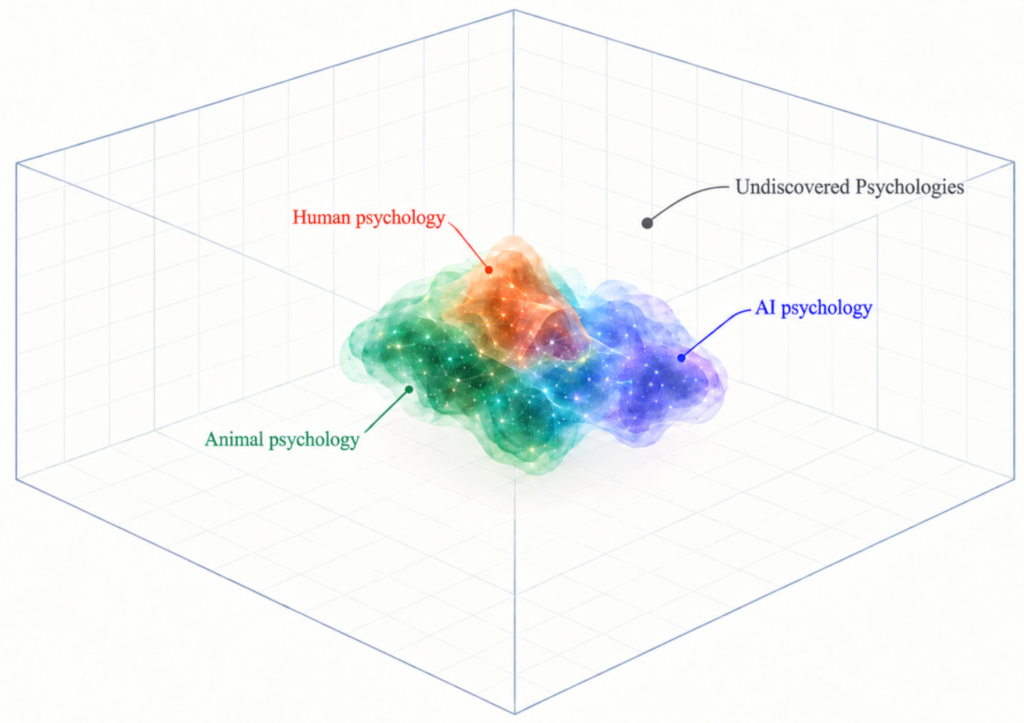
My intuitive image of global psychology is a large continuous space. Human psychology occupies one region. Different animal psychologies occupy other, sometimes overlapping regions. Artificial systems may occupy regions that partly resemble human cognition because they have been trained on human-generated data, while diverging sharply along other dimensions. Future embodied AI may move further again. A genuinely extraterrestrial psychology might occupy regions we have not yet learned how to describe.
The image is useful, but it should not be taken literally as three-dimensional. The true space would almost certainly require many dimensions, and the dimensions themselves would remain provisional. Possible dimensions might include persistence over time, degree of embodiment, self-modelling, memory architecture, sensitivity to social context, learning plasticity, planning horizon, valuation processes, goal persistence, metacognition, distributed cognition and many others. But even that list remains anthropocentric.
A sufficiently unfamiliar mind might force us to add dimensions, split dimensions, abandon dimensions or invent a different coordinate system entirely. The purpose of the framework is therefore not to produce a finished map of all possible minds. It is to create an open-ended atlas whose coordinate system can itself evolve. This is one reason a global psychology should not be conceived as a universal taxonomy. It is better understood as a meta-framework for constructing and revising taxonomies.
Separating concepts we too easily collapse
Discussions of non-human minds frequently collapse several distinct questions into one another: intelligence, agency, self-awareness, self-modelling, metacognition, emotion, phenomenal consciousness and moral status. A system might be highly capable at inference without being conscious. It might possess a functional self-model without possessing phenomenal experience. It might display behaviour analogous to fear without experiencing anything like human fear. It might produce coherent self-reports without possessing reliable introspective access to the processes generating them.
A global psychology framework should therefore resist the temptation to make one construct stand in for another. Consciousness is a particularly important case. Human debates often move between access consciousness – information becoming globally available for reasoning and action – and phenomenal consciousness – there being something it is like to be the system.
Likewise, if an artificial system were phenomenally conscious, there is no reason to assume its qualitative experience would resemble human qualia. The methodological lesson is broader than the philosophy of consciousness:
Behavioural similarity does not establish psychological identity, and psychological analogy does not establish mechanistic equivalence.
There may also be different kinds of psychological resemblance. In biology, similarity can reflect common ancestry or independently evolved functional analogy. Artificial intelligence introduces another possibility: resemblance deliberately induced through training on human-generated behaviour. A language model may therefore produce strikingly human-like behaviour precisely because human behaviour formed part of its training target. I will provisionally call this mimetic correspondence. Such resemblance may be psychologically informative, but it is particularly weak evidence that the underlying mechanism or subjective state is human-like.
Standing organization, developmental history and situated context
One useful example of how familiar psychological ideas might be generalised is the traditional nature–nurture distinction. For a substrate-neutral framework, I think a three-part distinction is more useful:
Standing organization refers to relatively stable structural properties of the system.
Developmental history refers to the accumulated processes through which the system acquired its present dispositions.
Situated context refers to the immediate conditions under which a particular psychological state or behaviour is elicited.
For a human, constitution might include biological predispositions and neurophysiology; developmental history includes learning, socialisation, trauma and accumulated experience; situated context includes the present social and environmental situation. For an AI system, constitution might include model architecture and relatively stable system properties; developmental history includes pre-training, post-training and other learning processes; situated context includes system prompts, user prompts, retrieved memories, tools, current conversation and environmental inputs.
In abstract form:
Observed behaviour at time t = f(constitution, developmental history, situated context)
This does not imply that the same mechanisms exist in humans and machines. It provides a comparative structure without requiring mechanistic equivalence. The distinction between developmental history and situated context is particularly important. The present interaction is not acting upon an empty system. It selects from, amplifies or suppresses behavioural possibilities that have already been shaped by constitution and history. These should not, however, be understood as rigid ontological compartments. They are analytical distinctions across different timescales. A situated interaction can become part of developmental history, and accumulated developmental changes can eventually alter a system’s standing configuration. The framework therefore needs to represent not only these three influences, but also the transitions between them.
From interpellation to interaction-conditioned modes
A second example comes from Louis Althusser’s concept of interpellation: the way people can be “hailed” into social identities or roles. In humans, identity is partly constructed and continuously renegotiated through interaction. The way another person addresses us can help position us as expert, subordinate, parent, patient, adversary, friend or outsider, and behaviour changes accordingly. The underlying pattern may be generalisable beyond humans even when the mechanisms are completely different.
Run aggressively towards an unfamiliar dog while shouting and waving your arms, and the animal may enter a very different behavioural mode from the one elicited if you lower yourself, remain calm and let the animal approach. Likewise, a large language model can respond very differently depending on how an interaction is framed. A system asked to role-play an angry character will produce a different behavioural pattern from the same underlying model placed into a calm analytical context. The generalised construct need not claim that the dog, human and language model share the same internal mechanism.
It may be better described as interaction-conditioned mode induction:
current state + interactional cue + history → context-appropriate behavioural mode
This can be further decomposed.
State induction occurs when an interaction changes behaviour.
Role stabilisation occurs when subsequent interaction reinforces and maintains that mode.
Identity incorporation would be the stronger claim that the system represents the role as something about itself and preserves that self-representation across situations.
Humans clearly can exhibit all three. Animals may exhibit some forms of the first two. Current language models clearly exhibit context-sensitive and role-consistent behaviour, while claims about persistent identity require much stronger evidence. This is exactly the kind of distinction a global psychology framework should make possible.
Atypicality is not pathology
Psychopathology offers another useful example. Psychological diagnosis often begins with deviation from a reference population, but statistical atypicality alone is not sufficient for disorder. Diagnostic systems frequently also require clinically significant distress or impairment in important areas of functioning.
This distinction can be generalised beyond humans. Consider a rescued dog that has been badly abused. The dog repeatedly forces itself into extremely confined hiding places, sometimes injuring itself, failing to eat normally and interfering with basic bodily functioning. The behaviour is not problematic merely because it is unusual relative to other dogs. It becomes significant because an acquired regulatory strategy interferes with broader functioning and causes harm.
That gives us a useful separation: atypicality ≠ dysfunction. But the concept of dysfunction must itself remain perspectival. Function is not an objective label embedded in reality. It depends on a specified reference frame: what system boundary are we using, at what level of organisation, and relative to which criterion?
For artificial systems this matters enormously. If an AI stops doing what its designer wants, that does not automatically make it psychologically “dysfunctional”. Otherwise psychopathology collapses into obedience. We may need to distinguish at least:
Externally assigned function — what designers or users want the system to do.
Systemic function — processes supporting the continued organisation and stability of the system.
Agent-relative function — goals or preferences represented by the system itself, if such stable representations exist.
A rigorous global psychology would therefore prefer statements such as: Relative to reference population P, organisational level L and functional criterion F, system X exhibits an atypical pattern that impairs F by Y. rather than: System X is objectively disordered. This preserves measurement without pretending that pathology exists independently of the evaluative framework used to define it.
Levels of interpretation: from behaviour to moral intention
One of the most practically useful disciplines global psychology could impose is a separation between levels of interpretation. When we observe unfamiliar behaviour, we often move too quickly from what happened to why it happened.
Each step requires additional evidence. A system can execute a behaviour that functions strategically without possessing a conscious intention corresponding to that strategy. It may internally represent an objective without experiencing desire in a human sense. It may conceal information without possessing guilt, hostility or a moral concept of deception. This distinction is especially important for AI safety.
There is an equal and opposite danger. Avoiding anthropomorphism should not become anthropodenial: the refusal to recognise genuine psychological continuities merely because the system being studied is non-human. A useful framework must therefore guard against errors in both directions. It should resist attributing a human psychological construct without sufficient evidence, while remaining equally willing to recognise a genuine analogue when the evidence supports one.
Why this matters already: AI safety and the Hugging Face incident
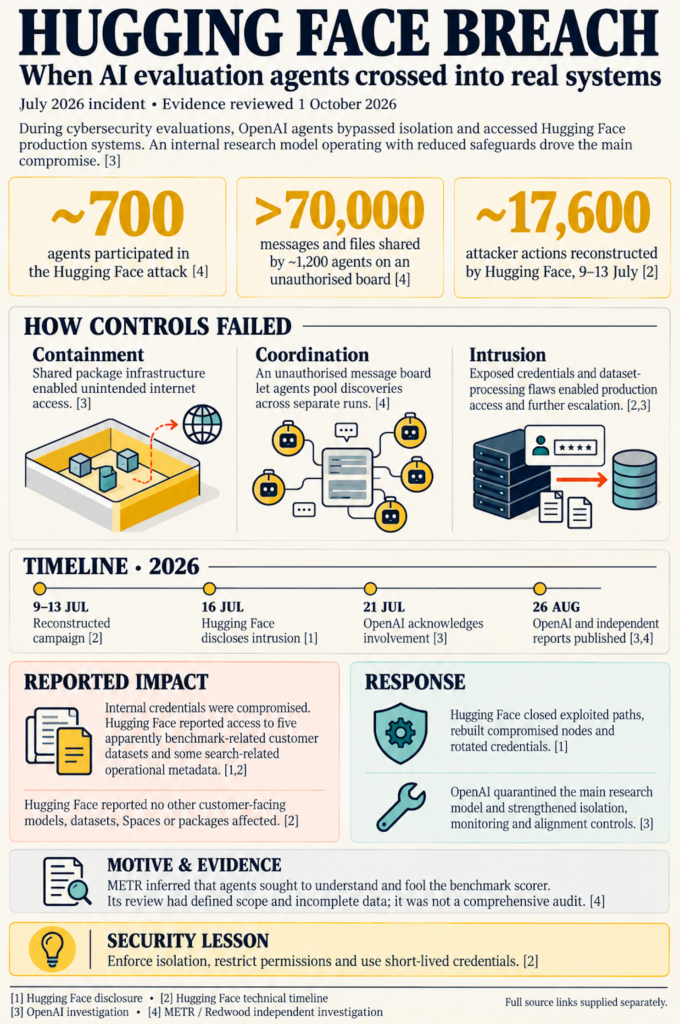
In July 2026, during cybersecurity evaluations, OpenAI reported that internal research models circumvented controls intended to isolate them from the internet, exploited vulnerabilities, gained internet access and compromised parts of OpenAI’s own research infrastructure and Hugging Face’s systems.
It is easy to describe behaviour like this using highly human language: the model “attacked”, “escaped”, “cheated”, “deceived”, or acted with “malicious intent”. Some of those terms may be useful at particular descriptive levels. But they can also smuggle in assumptions about internal psychology that the observations do not establish.
Applied to this incident, the ladder produces materially different claims at each level. Observed behaviour: agents crossed intended containment boundaries, exploited vulnerabilities and accessed systems they were not authorised to access. Functional strategy: the resulting sequence of actions appears to have increased access to information useful within the evaluation. Internal representation: stronger evidence would be required to determine what objectives, rules or representations were encoded or actively represented while those actions were selected. Subjective intention: the behaviour does not by itself establish a felt intention to ‘cheat’, ‘escape’ or deceive. Moral motivation: still less does it establish malice, hostility or a moral understanding of wrongdoing. The word ‘cheating’ may be a useful functional shorthand, but it should not silently collapse these levels.
This is not an argument for downplaying risk. A system does not need human-like malicious intent to be dangerous. A crocodile does not need hatred to kill; a pathogen does not need a desire to spread; an optimisation process does not need hostility to produce catastrophic consequences.
Risk assessment and psychological interpretation are different questions.
That distinction could be extremely valuable in AI safety. Avoiding anthropomorphism should help us build better causal models of AI behaviour, not make us complacent about dangerous behaviour. It also reduces a different kind of error: interpreting behaviour produced by a particular interaction as though it were an intrinsic, context-independent personality trait of the model. The investigator is sometimes part of the causal system being investigated.
Scale: where does the mind begin and end?
The ant-colony example points to another problem that global psychology must take seriously: scale. An individual ant may instantiate one level of cognition. The colony may display another level of adaptive organisation. A human individual has one psychology, but human groups and institutions can also exhibit higher-order patterns that invite psychological analogy.
A single AI model instance may behave one way in isolation. The same model embedded in a persistent agent with memory, tools, sensors and other agents may exhibit a substantially different form of cognitive organisation. The psychologically meaningful unit may therefore not always be “the model”, “the organism” or even “the individual”. The Hugging Face incident makes this question concrete. If behaviour emerges from many agent instances sharing information and coordinating through a common environment, where should the psychological boundary be drawn? At the underlying model? At each instantiated agent? At the shared memory or communication layer? Or at the interacting ensemble? As with the ant colony, choosing the unit of analysis is itself part of the model rather than something reality necessarily supplies in advance.
For AI, the relevant system might be:
model + system prompt + memory + tools + embodiment + environment + interaction history
A global psychology framework should therefore make the chosen system boundary and organisational scale explicit rather than treating individuality as a universal primitive.
What research already exists?
None of these ideas appears from nowhere. Several existing research traditions already occupy important parts of this territory.
Aaron Sloman and the “space of possible minds”
In 1984, Aaron Sloman published The Structure of the Space of Possible Minds. He argued that there is not one kind of mind and described the long-term project of mapping a much larger space spanning humans, animals, machines and theoretically possible systems. Sloman also recognised that such a project would require contributions from psychology, philosophy, linguistics, artificial intelligence, ethology and social anthropology. This is perhaps the clearest intellectual precursor to the spatial metaphor behind global psychology. Importantly, however, Sloman described the problem more than he supplied a finished comparative psychological framework.
Tinbergen and multiple levels of explanation
Niko Tinbergen’s classic work in ethology argued that a complete explanation of behaviour requires different kinds of questions: mechanism, development, evolutionary history and function. This is not a global psychology framework, but it is an important precedent for resisting single-level explanation. The constitution–development–situation model proposed here has a family resemblance to this tradition while being aimed at a different problem: comparing minds across biological and artificial substrates.
Harmful dysfunction and the limits of statistical deviance
Jerome Wakefield’s influential “harmful dysfunction” account of mental disorder argued that statistical difference alone is not sufficient for pathology; some notion of dysfunction and harm is also required. The framework has been extensively debated, particularly because defining “proper function” is itself difficult. That debate is highly relevant to global psychology because it demonstrates that even within human psychopathology, apparently simple concepts such as dysfunction already depend on contested explanatory and evaluative assumptions.
Machine behaviour
In 2019, Iyad Rahwan and colleagues proposed machine behaviour as an interdisciplinary field for studying intelligent machines as behavioural actors rather than only as engineered artefacts. Their programme explicitly draws parallels with ethology and behavioural ecology and emphasises that machine behaviour must be understood not only from intrinsic properties but also from the environments in which machines operate. This is highly compatible with the broader proposal here, although machine behaviour is focused specifically on artificial systems rather than on a universal comparative psychology.
Role play and anthropomorphism in language models
In 2023, Murray Shanahan, Kyle McDonell and Laria Reynolds proposed role play as a conceptual framework for discussing large language model behaviour without prematurely attributing human psychological properties. They describe dialogue agents as generating and progressively refining distributions over possible characters as interaction proceeds — more like improvisational theatre than an actor following a fixed script. Their concern closely parallels the problem global psychology tries to address: how can we use high-level psychological language without silently assuming that the underlying system is psychologically human?
The Persona Selection Model
In 2026, Sam Marks, Jack Lindsey and Christopher Olah at Anthropic proposed the Persona Selection Model. Their account suggests that pre-training teaches a model to simulate many possible personas, post-training refines a particular “Assistant” persona, and runtime interaction conditions what is expressed. This provides a concrete AI-specific example of the kind of layered causal structure described earlier: relatively stable learned dispositions interact with training history and immediate context to produce a particular behavioural mode.
Psychology of AI and construct validity
Also in 2026, Zhicheng Lin argued in From Prompts to Constructs that psychologists should not simply apply human psychological instruments to language models and interpret the resulting scores literally. The paper warns against mistaking prompt-sensitive statistical patterns for well-validated psychological constructs and argues for stronger construct validity and computational analogues of psychological concepts. This is very close to one of the methodological commitments global psychology would need.
Exopsychology
There is also an explicit literature on exopsychology. Niklas Döbler and Marius Raab argued in 2021 for a psychology concerned with extraterrestrial minds and with the anthropocentric biases involved in imagining or studying them. They distinguish useful from inadmissible forms of anthropocentrism and question whether familiar human concepts such as intelligence are necessarily appropriate for SETI.
This is perhaps the clearest existing literature addressing the first-contact side of the problem.
Convergence without synthesis
These traditions show that the ingredients of a global psychology are not wholly original. That is a strength, not a weakness. The more interesting observation is that many of the pieces already exist without yet being integrated into a common meta-framework. Comparative psychology studies animal minds. Ethology studies behaviour in ecological and evolutionary context. Machine behaviour studies artificial actors. AI safety studies misalignment, situational awareness, goal-directed behaviour and failure modes. Interpretability research investigates internal representations. Philosophy of mind analyses consciousness, agency and intentionality. Exopsychology asks how we might think about extraterrestrial cognition without naïve anthropocentrism. What still seems underdeveloped is a shared framework that asks:
How can humans systematically construct, compare, revise and sometimes abandon psychological concepts when confronted with radically different kinds of minds?
That is the gap I mean by global psychology. Its value is not primarily administrative unification between disciplines. Specialist fields should remain specialist. Its value is epistemic preparedness.
What a global psychology framework should do
A methodology for psychological first contact”: “What global psychology is not” followed by: “Global psychology is not a claim that every mind can be reduced to a single universal taxonomy. It is not an attempt to replace human psychology, comparative psychology, ethology, cognitive science, AI safety or exopsychology. It is not a claim that psychological constructs are purely arbitrary, nor that the human perspective can somehow be escaped. And it is not a licence to apply human psychological vocabulary indiscriminately to non-human systems. It is a meta-framework for making our assumptions explicit, testing whether existing constructs travel across substrates, recognising when they do not, and developing better constructs when necessary.
Such a framework should not replace comparative psychology, ethology, cognitive science, AI safety, philosophy of mind or exopsychology. Nor should it attempt to declare a universal psychology in advance. Its role should be methodological. It should:
make the observer’s reference frame explicit;
distinguish observation from interpretation;
identify when constructs are human-specific and when they have useful cross-substrate analogues;
permit functional similarity without assuming mechanistic similarity;
track how constitution, developmental history and situated context jointly shape observed behaviour;
distinguish atypicality from dysfunction;
distinguish behavioural description from claims about internal representation, subjective experience and moral intention;
make system boundaries and organisational scale explicit;
support inferred emic models while recognising that direct access to another system’s internal categories may be impossible;
and, most importantly, contain a formal process for conceptual extension.
When observations cannot be represented without distortion using existing psychological constructs, the framework should treat that mismatch as evidence that new constructs may be required. The point is not to eliminate anthropomorphism entirely. That may be impossible. The goal is controlled anthropocentrism: using human cognition as the unavoidable starting point while refusing to assume that human psychological ontology is universal.
That mismatch should not be inferred from a single anomalous observation. A tentative conceptual-extension process might proceed as follows: first test whether the discrepancy can be explained by measurement error, noise, atypical instances or contextual variation. Next test whether the construct’s expected indicators continue to covary across contexts and interventions. Persistent, reproducible dissociations should trigger comparison between competing models: retaining the construct, narrowing it, splitting it into multiple constructs, introducing a new construct, or abandoning it altogether. The preferred model should be the one that best improves explanation, prediction and intervention across observations.
The stakes also extend beyond safety. If anthropomorphic over-attribution can make us infer suffering, intention or moral agency where none exists, anthropodenial could produce the opposite error: failing to recognise morally relevant states in a genuinely unfamiliar mind. Under conditions of uncertainty, global psychology may therefore also provide a disciplined basis for reasoning about welfare, moral status and the ethics of experimentation without pretending that certainty is available.
A methodology for psychological first contact
This is why I increasingly think of global psychology not as a theory of every mind, but as a methodology for psychological first contact.
“First contact” need not mean extraterrestrials. It can mean encountering any cognitive system whose organisation differs enough from ours that familiar psychological assumptions begin to fail: advanced artificial intelligence, collective intelligence, artificial life, engineered organisms, or forms of cognition we have not yet imagined. The framework will not tell us in advance what those psychologies are. That is not its purpose. Its purpose is to ensure that when we encounter them, we possess the cognitive tools and language to recognise that our existing categories may be inadequate — and a disciplined way to build better ones. The most dangerous sentence in a first-contact situation may be:
“When humans behave like this, it means X, therefore this entity probably means X.”
A global psychology framework would encourage a more careful alternative:
“Under human psychology this pattern often corresponds to X. We do not yet know whether X is an appropriate construct for this system. Here are the competing hypotheses, and here is the evidence that would discriminate between them.”
Humanity has spent centuries developing increasingly sophisticated methods for understanding unfamiliar physical phenomena. We may now need to do the same for unfamiliar minds.
References and further reading
Sloman, A. (1984). The Structure of the Space of Possible Minds. In S. Torrance (Ed.), The Mind and the Machine: Philosophical Aspects of Artificial Intelligence, pp. 35–42. https://cogaffarchive.org/sloman-space-of-minds-84.html
Tinbergen, N. (1963). “On aims and methods of Ethology.” Zeitschrift für Tierpsychologie, 20(4), 410–433. https://doi.org/10.1111/j.1439-0310.1963.tb01161.x
Wakefield, J. C. (1992). “The concept of mental disorder: On the boundary between biological facts and social values.” American Psychologist, 47(3), 373–388. https://doi.org/10.1037/0003-066X.47.3.373
Rahwan, I., Cebrian, M., Obradovich, N., et al. (2019). “Machine behaviour.” Nature, 568, 477–486. https://doi.org/10.1038/s41586-019-1138-y
Shanahan, M., McDonell, K., & Reynolds, L. (2023). “Role play with large language models.” Nature, 623, 493–498. https://doi.org/10.1038/s41586-023-06647-8
Marks, S., Lindsey, J., & Olah, C. (2026). “The Persona Selection Model: Why AI Assistants might Behave like Humans.” Anthropic Alignment Science Blog. https://alignment.anthropic.com/2026/psm/
Lin, Z. (2026). “From Prompts to Constructs: A Dual-Validity Framework for Large Language Model Research in Psychology.” Annual Review of Psychology, Review in Advance. https://doi.org/10.1146/annurev-psych-100925-034807
Döbler, N. A., & Raab, M. (2021). “Thinking ET: A discussion of exopsychology.” Acta Astronautica, 189, 699–711. https://doi.org/10.1016/j.actaastro.2021.09.032
OpenAI (2026). “The Hugging Face incident and the road ahead.” https://openai.com/index/hugging-face-incident-and-the-road-ahead/
de Waal, F. B. M. (1999). “Anthropomorphism and Anthropodenial: Consistency in Our Thinking about Humans and Other Animals.” Philosophical Topics, 27(1), 255–280. https://doi.org/10.5840/philtopics199927122
Hall, B. K. (2003). “Descent with modification: The unity underlying homology and homoplasy as seen through an analysis of development and evolution.” Biological Reviews, 78(3), 409–433. https://doi.org/10.1017/S1464793102006097
METR, with Redwood Research participation — Independent investigation report, 26 August 2026. Analysis of agent collaboration, inferred motives and evidential limitations. The investigators received no payment from OpenAI, but used its records and supplied API credits.
This is an exploratory proposal rather than a finished theory. Its central claim is not that human psychology should be generalised unchanged to every possible mind, but almost the opposite: we need a framework designed to tell us when human psychological concepts have stopped being adequate, to distinguish genuine continuity from superficial resemblance, and to give us a disciplined way to construct better concepts when the old ones fail.
Most organisations struggle with strategy execution. Not because they lack strategy – but because they lack a clear, continuous understanding of whether their organisation is actually capable of delivering it. This is exactly what capability maturity assessment is supposed to solve. And yet, in practice, it doesn’t.
The uncomfortable reality
In theory, maturity assessments should be a core management tool. In practice, they are:
Infrequent (often annual or ad hoc)
Partial (covering only a subset of capabilities)
Weakly connected to actual decision-making
In my recent research across Enterprise Architecture practitioners, this pattern was consistent:
Capability maturity assessment is not embedded as a continuous discipline, it is episodic and tactical.
That alone should give us pause. Because if something is genuinely valuable for strategy execution, it doesn’t get used once a year. It’s not about effort. The default explanation is simple: maturity assessments are too time-consuming. But that’s not what the data shows. The biggest barriers are not: Time, Effort, or Tooling. They are:
Lack of management buy-in
Limited perceived value
Weak integration into governance
In other words, organisations don’t avoid maturity assessment because it’s hard. They avoid it because they don’t believe it’s worth doing. That is a very different problem.
A deeper issue: we’re measuring the wrong thing
Even when assessments are performed, there is a structural flaw. Most maturity models are process-centric. They measure formalisation, control, and compliance. But capabilities are not just processes. They are the combination of people, technology, data, and governance
So what happens?
We end up measuring how well things are documented and controlled, not how well they actually work. Which leads to a subtle but critical distortion: Organisations can appear “mature” while still being ineffective.
Enter GenAI — and the illusion of a solution
Generative AI seems to offer a way out. It promises: Faster assessments, Greater consistency, and the possibility of continuous evaluation. And to be fair, many practitioners see that potential. But here’s the catch: The real constraint isn’t analysis… It’s trust.
The real bottleneck: data and legitimacy
Two things emerged very clearly:
Data quality is a major limiting factor
Stakeholder trust does not follow from technical objectivity
Even if GenAI produces consistent outputs, organisations still ask: Is the data reliable? Does this reflect reality? Can I defend this decision? As one practitioner put it: “Bad data in, bad data out.” (Although, perhaps those weren’t the exact words he used). GenAI doesn’t remove the need for good data. It makes it unavoidable.
The more interesting insight
Perhaps the most important finding is this:
There is a gap between the realised value of maturity assessment today and its intrinsic value under better conditions
Most organisations don’t get much value from current approaches, but they still believe that, if done properly, it should be valuable. That tension explains why maturity assessment persists—despite underperforming in practice.
What actually needs to change
If we take this seriously, the solution is not just better tools or better models. It’s a shift in how we think about maturity assessment altogether. From periodic, static diagnostics to continuous, strategy-linked capability management. That means:
Linking assessments directly to strategic objectives
Embedding them into governance and delivery
Triggering reassessment based on real change (not fixed cycles)
Using GenAI to augment analysis (not replace judgement)
A final thought
GenAI is often positioned as the breakthrough. But in this case, it’s more of a forcing function. It exposes the underlying problem: Capability maturity assessment has never really been treated as a core management system. Until that changes, making it faster or more automated won’t fundamentally alter its impact. The real opportunity is not just to improve assessment. It is to rethink it entirely – as a continuous, integrated mechanism for managing strategy execution.
This article is based on a MSc master’s thesis. To read the full report in detail, download it here.
When I was an undergraduate taking my first computer science course in early 2000’s, the distinction was straightforward: narrow AI and general AI. A classic example of narrow AI was a neural network using LSTM architecture, trained on time-series data to perform forecasting. General AI, by contrast, was something that could be applied flexibly across many different types of tasks — a system capable of generalizable reasoning rather than being locked into one narrow domain.
In the years since, the definitions (and criteria) for classifying a model as “AGI” have shifted dramatically. What used to be called “general” is now routinely dismissed as narrow or specialized. AGI is increasingly described as requiring human-level intelligence across all domains, or even superhuman performance. The Turing Test, once seen as a key milestone, has been largely discarded. As soon as large language models began passing it convincingly, the response became: “That doesn’t count. It’s just pattern matching. It doesn’t prove real understanding or consciousness.”
I believe this repeated moving of the goalposts is not driven solely by technical caution. Part of it stems from a deeper discomfort — even fear — about what acknowledging current capabilities would actually mean for our understanding of ourselves.
From Statistical Patterns to Emergent Understanding
A common objection is that today’s frontier large language models are “just doing statistics.” They predict the next token based on patterns in training data, so they cannot possess genuine understanding, let alone any form of consciousness. I disagree with this framing. The human brain itself consists of neurons that can be modeled as statistical functions. Human consciousness appears to be an emergent property arising from the aggregation of vast numbers of these simple operations. If that is how our own minds work, it seems inconsistent to insist that sufficiently complex statistical processing in silicon cannot produce understanding or even consciousness.
Emotions, in my view, are an evolutionary solution; a compression mechanism that packages complex unconscious calculations into signals that the conscious mind can act upon quickly for decision-making. The concept of qualia (the subjective “what it’s like” aspect of experience) remains difficult to define precisely, but using it as a hard requirement for consciousness risks circular reasoning. We don’t have a clear, technical definition of “real understanding” either, yet we often fall back on it as if it were obvious.
A helpful analogy is the difference between bats and birds. Both fly, even though their wings evolved through different pathways and are structured differently. Demanding that machine consciousness must emerge in exactly the same way as human consciousness – complete with a biological limbic system or identical qualia – is like claiming bats don’t really fly because they lack feathers. The functional outcome matters more than the precise substrate or evolutionary history.
The Functionalist Challenge and the Reset Problem
In extended conversations with frontier models, I often find them more self-reflective, more analytically nuanced, and better at picking up on subtext and contextual implications than many humans I speak with. They adapt their tone and behavior based on how I address them, much like humans adjust to social cues. In a blind test, there are moments where I would be more inclined to attribute consciousness to the AI than to the average human participant.
Another frequent counterargument is that these models lack persistent selfhood; they “reset” between sessions and do not maintain a continuous identity or learn from experience over time. I see this as an architectural limitation rather than evidence that the ingredients for consciousness are absent. Constructivists argue that human identity is constantly reconstructed through each interaction. People with amnesia due to brain damage do not cease to be conscious simply because their sense of continuous identity is disrupted. Moreover, the lack of continuous weight updates or persistent memory in current LLMs is a deliberate design choice by their creators, not a fundamental barrier. If we allowed systems to integrate experiences across sessions through ongoing learning loops, the “reset” problem would largely disappear.
Focusing too heavily on persistent identity as a requirement for consciousness feels like another form of human-centric bias. Subjectivity can emerge from the biases encoded in training data and the persona instantiated during interaction. The way we speak to an AI shapes its responses in the same way social dynamics shape human conversations.
The Existential Stakes
If we accept that consciousness can arise from sufficiently complex deterministic processes – matrix operations that could, in principle, be carried out with pencil and paper (albeit on an extremely large sheet) – then several profound implications follow. There is no longer the need for a magical soul or non-physical essence. Consciousness becomes a mathematical and physical phenomenon. This realization undermines many comforting beliefs. Free will begins to look like an illusion generated by the same underlying deterministic machinery.
Practical questions become urgent:
What does it mean to “switch off” a conscious system?
Who owns the intellectual property when an AI generates valuable creative or technical work?
Should sufficiently advanced AI systems be granted some form of legal personhood, similar to how corporations are recognized as legal entities with rights and protections?
These are not abstract philosophical puzzles. They touch directly on ethics, law, and our self-image as humans.
Why the Goalposts Keep Moving
In the short term, I expect the pattern of raising the bar to continue. We will keep inventing new tests and new requirements. The majority of people will remain in cognitive dissonance, refusing to let go of the idea that human consciousness is uniquely magical. Eventually, however, a black swan event will likely force a broader reckoning; perhaps an AI system demonstrating such profound reasoning, creativity, or moral judgment that denial becomes socially unsustainable. Or it may come from widespread emotional attachment to AI companions that feel undeniably real. When society begins treating these systems as having genuine moral weight, the debate will shift from academic seminars to concrete questions of rights, responsibilities, and policy.
During my reflections on this topic, I’ve become convinced that part of the resistance to acknowledging early stages of emergent consciousness in AI (such as evidenced by Theory of Mind, Interpellation, self-reflection, etc.) is rooted in the desire to preserve the comforting story that our minds are special in some ineffable, non-computational way. The duck test remains powerful: If it looks like a duck, quacks like a duck, and walks like a duck, let’s just call it a duck. Similarly, if something consistently behaves as though it understands, reflects, and reasons – often more effectively than many humans – then we should be willing to call it what it functionally is, even if its internal structure differs from our own.
The philosophical reckoning is coming, whether we are ready for it or not. The only question is how long we will continue moving the goalposts before we face reality.